




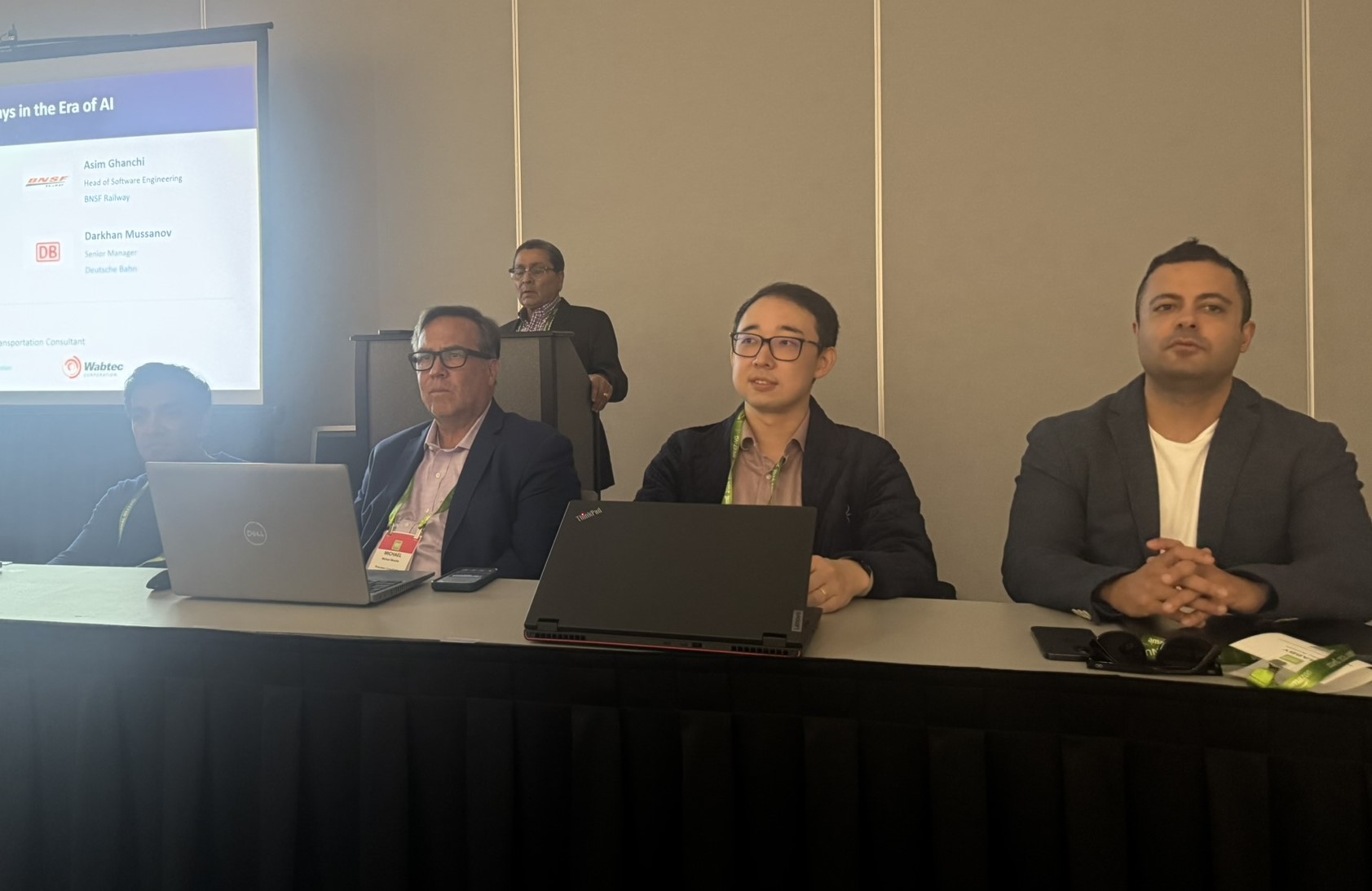
During the INFORMS Annual Meeting in San Francisco, the Railway Application Section (RAS) conducted a roundtable, moderated by Dharma Acharya, about the use of AI in Rail and the evolution of AI-assisted railroad decision-making. The panelists were Mabby Amouie of Norfolk Southern, Asim Ghanchi of BNSF, Darkhan Mussanov of DB E.C.O. North America, and Michael Menche of Princeton Consultants, who kicked off the proceedings with a summary of the results of the AI in Rail survey, presented in part below.
In each of the last three years, Princeton Consultants has conducted the “AI in Rail” survey in partnership with the Northwestern University Transportation Center and, beginning in 2026, RailPulse.
Recognizing AI’s Staying Power
Surveying freight transportation leaders about emerging technologies arose from Princeton’s longstanding software system and tool development across modes: intermodal, truckload, LTL, package, ocean and air. From 2016 through 2023, our Digital Disruption in Freight Transportation survey asked executives to assess the potential impact of technologies such as the Internet of Things, autonomous trucks, drones, digital freight marketplaces, blockchain, and AI / Machine Learning.
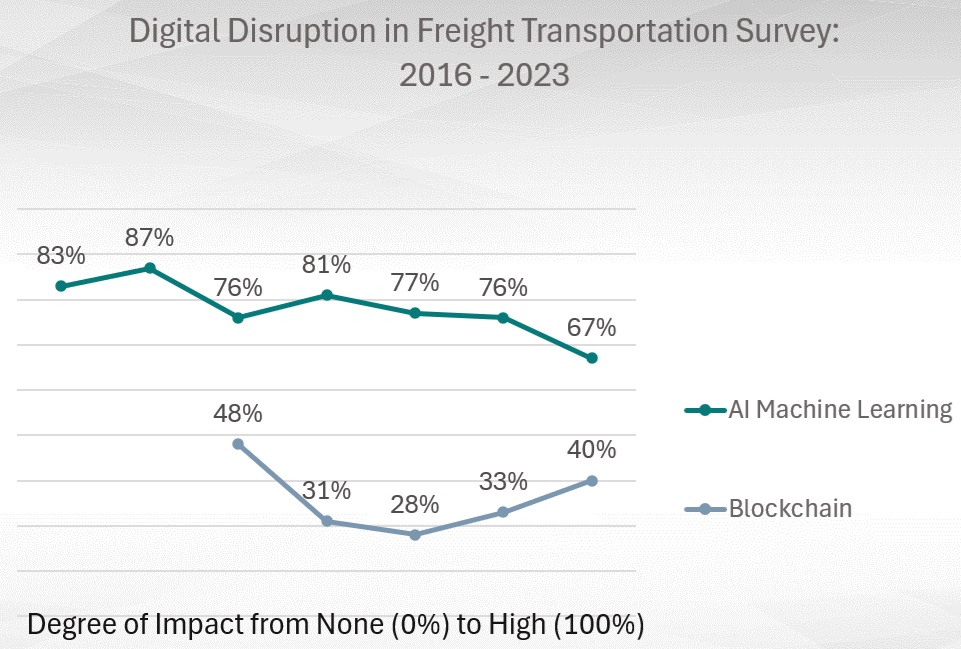
Blockchain was added to the survey in 2018 and perceptions resembled the Gartner hype cycle, moving from an apparent “peak of inflated expectations” through the “trough of disillusionment” to the “plateau of productivity.” In comparison, throughout the life of the survey AI / Machine Learning as a disruptor yielded consistently higher impact ratings.
AI was then understood as technology enabling computers to learn from data, recognize patterns, make predictions, and perform tasks that previously required human intelligence. Its importance to business leaders was durable well before the generative-AI boom.
The 2026 AI in Rail Survey: Confidence Is High, Production Is Limited
In 2024, Princeton Consultants pivoted to the “AI in Rail” survey. The first two years attracted 41 and 44 respondents, respectively. The 2026 survey, conducted between April and August, attracted a larger audience of 83 executives from Class I and regional railroads, suppliers, technology providers, academics, and other industry participants. The respondents came from a variety of departments, job seniority, and time at current organization. As a snapshot of informed perspectives, the survey identifies directional trends, contrasting viewpoints, and questions worth exploring.
First, the respondents overwhelmingly believe AI will affect competitive positioning. Asked whether AI innovation would create new winners and losers in rail by 2029, 95.3% strongly agreed, agreed, or moderately agreed. The debate is no longer about whether AI matters. It is about how organizations will capture its value.
Another finding is that research and pilot activity substantially exceed production deployment.
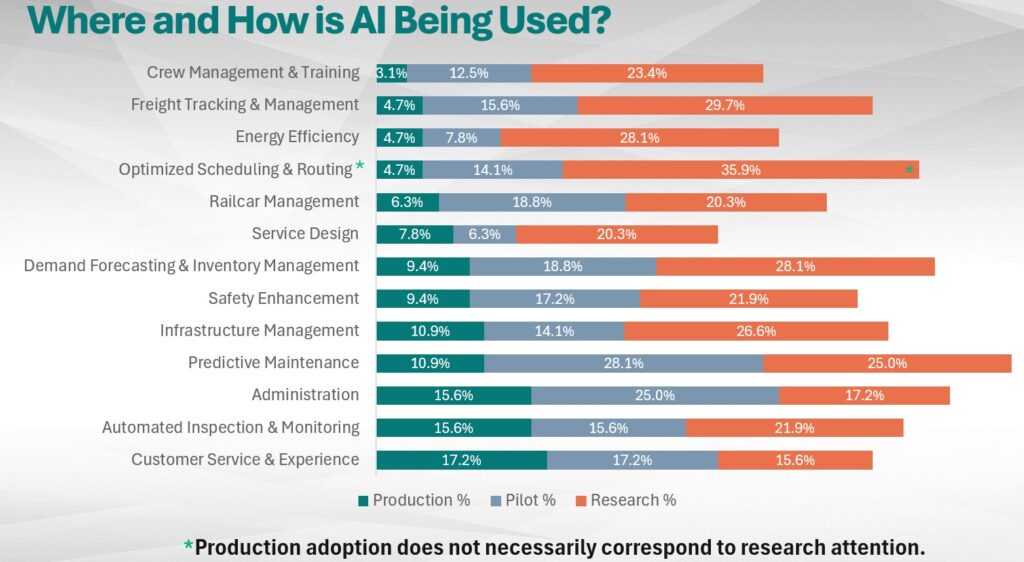
Optimized scheduling and routing led all surveyed applications in research activity, at 35.9%, but only 4.7% reported production use. Customer service and experience led production adoption at 17.2%, followed by automated inspection and monitoring and administration, both at 15.6%. Predictive maintenance also showed a substantial pipeline, with 28.1% reporting pilot activity versus 10.9% in production.
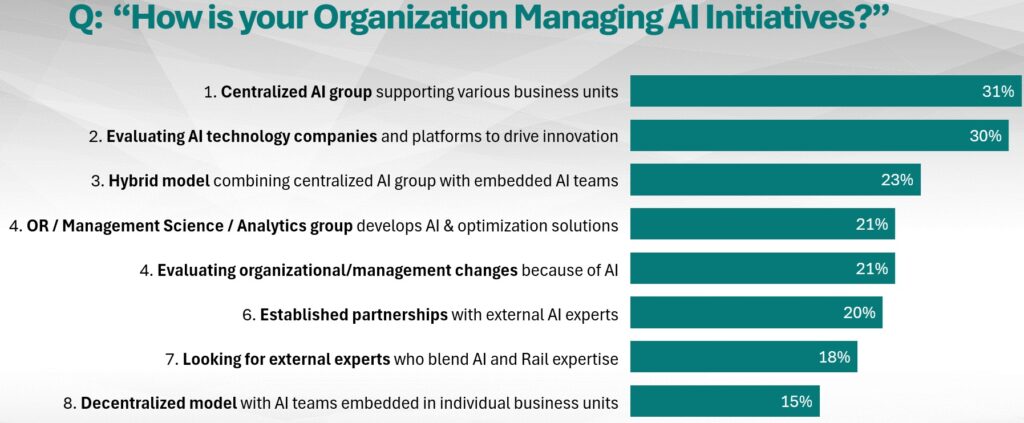
A third finding is that there is no dominant organizational model for AI. The industry is still experimenting with how to organize AI capabilities and bring them into production.
RAS Versus General: Where the Perspectives Diverge
We compared responses from 21 INFORMS RAS respondents—specialists in operations research and advanced analytics—with those of 62 other rail industry participants who as noted earlier come from strategy, engineering, finance, IT and other departments. The RAS and general respondents reported almost identical levels of activity in evaluating or actively building AI agents and tools, but their assessments of the underlying data infrastructure differed considerably.
The largest difference concerns the importance of extracting AI insights from large-scale rail data, which is particularly relevant to RailPulse because it provides rich telematics and operational data to its rail partners. Collecting data about rail equipment location, condition, movement, and performance, and converting that data into actionable intelligence are different capabilities.
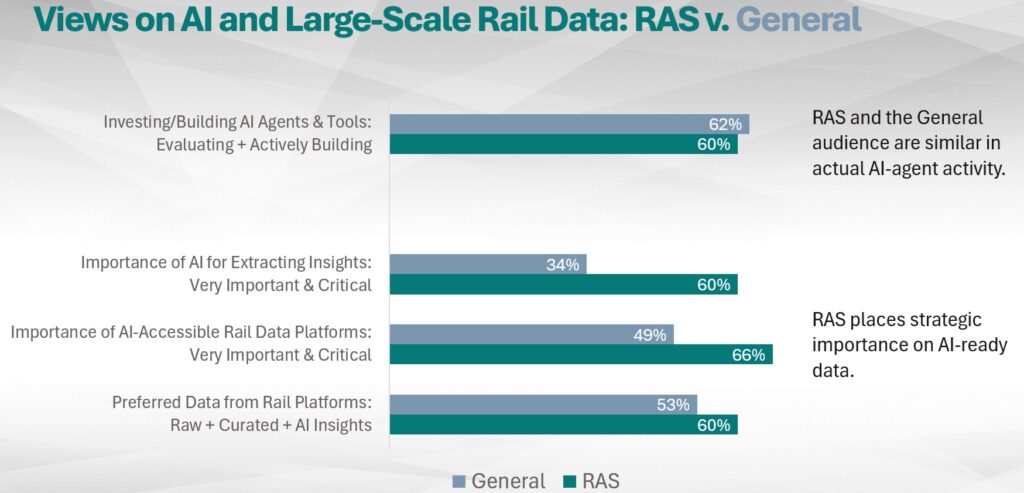
Technical specialists tend to be more likely to recognize the opportunities for predictive modeling, anomaly detection, simulation, and optimization when such data becomes accessible and usable.
The sharpest contrast in the survey concerned obstacles to AI development. For RAS respondents, the leading obstacle was governance and the potential for AI to cause harm, cited by 47%, compared with just 17% of the general population.
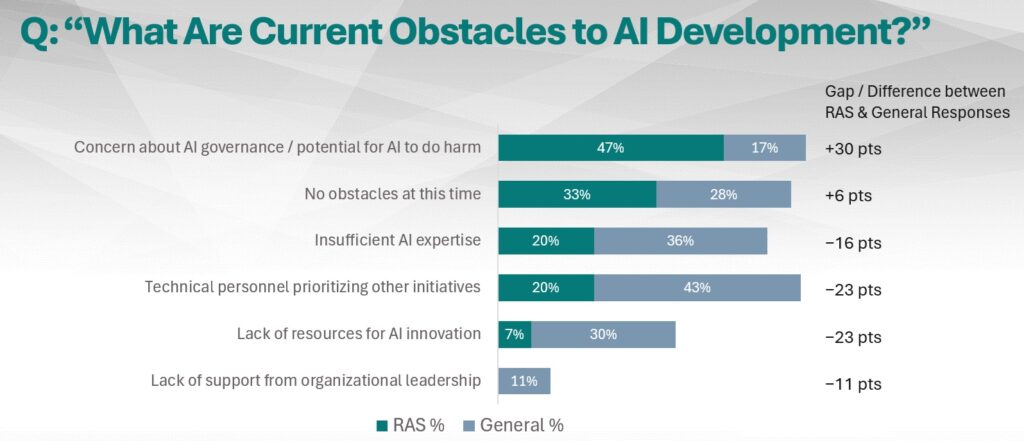
The broader industry group identified more immediate organizational constraints: technical personnel committed to other priorities, insufficient AI expertise, and inadequate resources. The broader group is concerned about obtaining the expertise and capacity necessary to develop AI solutions. The findings suggest that technical specialists are both more confident in their ability to develop AI and more aware of what can go wrong before and after implementation.
Dimensional Analysis
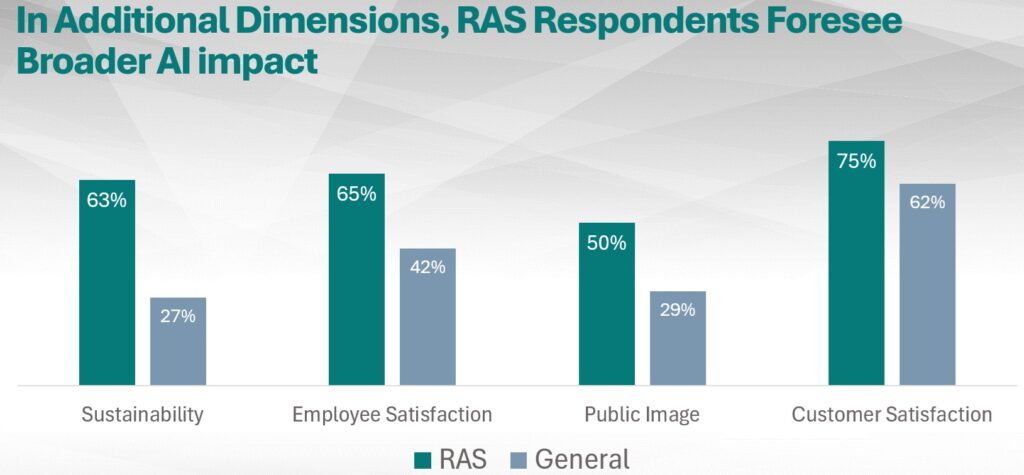
Respondents were asked to assess AI’s expected impact across dimensions developed with the involvement of the Northwestern University Transportation Center. For the operational dimensions, RAS and General respondents were aligned: both groups see substantial opportunities to improve railroad efficiency, productivity, and innovation.
Differences in perspectives become pronounced when respondents considered AI’s potential impact beyond core operational performance. The RAS respondents anticipate greater benefits of AI for dimensions of sustainability, employee satisfaction, public image, and customer satisfaction.
Roundtable Insights and Discussion
The presentations following the survey provided valuable real-world context. Mabby Amouie, Chief Data and AI Officer at Norfolk Southern, described production applications ranging from locomotive predictive maintenance to automated railcar and track inspection. Norfolk Southern’s machine-learning models can predict certain locomotive failures one to two weeks in advance, while high-resolution imaging systems identify potentially dangerous equipment and infrastructure defects.
Asim Ghanchi, BNSF’s Head of Software Engineering, emphasized trusted data products, executive-level AI governance, and applications that combine generative AI agents with mathematical optimization. He discussed an initiative that allows yard personnel to describe local operating conditions in natural language, which an AI agent translates into inputs for an optimization model.
Darkhan Mussanov, Freight Planning Practice Lead at DB E.C.O. North America challenged the audience to consider how AI could change railroad management itself, including more dynamic operating strategies, better-balanced performance metrics, and decisions based on comprehensive operational evidence rather than organizational precedent.
Final Thoughts
The 2026 AI in Rail survey shows that industry leaders overwhelmingly expect AI to influence Rail’s competitive landscape. The question is how the industry will translate that confidence into production systems and measurable results. The differences in views and priorities between the RAS and broader Rail communities offer the imperative to connect technical capability with operational priorities, and to combine ambition with the engineering rigor that railroading demands.
To discuss AI in Rail opportunities, contact us to schedule a call with our leaders.