





Irv was the first guest on The Decision Intelligence Lab, a podcast hosted by Professor Michael Watson (Northwestern University) and Professor Vijay Mehrotra (University of San Francisco) to “deliver real-world insights for data professionals, business leaders, and anyone seeking to leverage data for smarter decision-making.” Listen to the episode here. Following are lightly edited excerpts.
Vijay Mehrotra: Today’s guest is Irv Lustig, who I’ve known since we were graduate students. He’s had a fascinating career. Irv has done cutting‑edge research around optimization and optimization solvers. He has also played a variety of roles, including product management, sales, and marketing around optimization and data science technologies. He is currently with Princeton Consultants, and our primary topic today is “The Princeton 20.” Irv, could you give us an introduction?
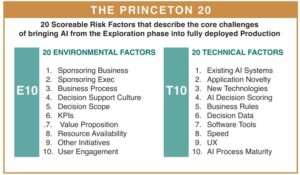
Irv Lustig: The Princeton 20 was created by Steve Sashihara, our CEO, as a framework to identify success and risk factors for the deployment of AI and Optimization. It is divided into 10 environmental factors, which address the business side and how you will start a project, and 10 technical factors, which address how you will build the solution and what it will look like in the context of the business. The Princeton 20 helps us identify issues that represent risk in a project, so we can make sure we can address them in advance.
Vijay: Do you get a sense from your clients that they get value from it?
Irv: They appreciate that we address risks up front instead of fighting fires later in the project. It is also helpful in our strategic consulting, when we help firms become better at managing their own projects.
Vijay: Is it your sense that generally in optimization, data science, and AI projects, that there is a lot of overselling of projects and products?
Irv: For sure. Let’s say we have a toolbox with an OR orientation like optimization and simulation—now we add machine learning and GenAI, and they are all hammers looking for nails. You have to find the right nail first so that you pull out the right tool to solve the problem. There is a lot of tool‑selling that goes on without people recognizing that, in general, the tool is a means to an end.
Michael Watson: Let’s dive in and talk about one of The Princeton 20 factors. Environmental Factor #5 is “Decision Scope.” In your white paper, you talk about encountering something too narrow or too broad. Can you expand on that?

Irv: This is generally about understanding a decision and its scope of impact on the entire business operations, and also the aspect of time, which is especially interesting in scheduling problems. In business environments, there is typically an existing schedule that personnel are executing toward. When disruptions happen, they modify the schedule to deal with what they think will happen in the future, the distant future, the midterm future, or the near future. That all relates decision scope—is the decision you are making today? How long will that decision be implemented? Will it change a group of operations in the business? Is the decision crisp and well‑defined so we will know if we have to start changing decisions elsewhere? Those are the kinds of things that we worry about regarding decision scope.
Vijay: Can you talk about factor E-7, “Value Proposition?”

Irv: We seek to understand how we will know the value of the solution. Value can typically be measured by saving money—minimizing cost or maximizing revenue or profit—or by making a decision faster. You might see someone making scheduling decisions that take a week using a spreadsheet, and you can present a tool that creates a solution in five minutes, which will change how they work. In evaluating that particular risk, if the value is difficult to quantify or measure, then it may be in scope to understand the actual value proposition.
Michael: Let’s go to factor T-10, “Process Maturity.” I was expecting a whole category for the ongoing maintenance of a solution. Optimization solutions need to be maintained. With data science and machine learning, you have to worry about drift. How much do you look at that? Is the organization going to be able to maintain the solution that you leave behind? How impactful is that?

Irv: In “process maturity,” we are assessing if the client teams done things with taking a decision support system based on an AI optimization technique. Are they highly experienced and successful with deployment and long-term support for that area? If they are in good shape, that is great. Maybe they have done it before in some business areas, but not in the area we are looking at, or maybe they have just done pilots and have no idea what deployment means.
At Princeton, deployment consists of two parts. One is the technical aspect: you are standing up an application where it is going to be on the cloud, and connects the data, and has security, and all of those aspects of deployment technically. The second relates to deploying into the business, which means that you are going to create the set of tools that they are going to use to start making decisions. Are the client team members ready to handle the change that will be involved in the business processes due to this new system being in place?
Consider if an organization’s team members have been making decisions on spreadsheets, such as scheduling on a spreadsheet and taking a week to do it, and now it can be done in an automated way. If there were 15 people making these schedules and now one person can create them all in one day, what will happen to the other people? How are their jobs going to change?
For a related example, consider that you are creating a scheduling optimization solution for a certain type of work, and you can show it will help execute that work with 50 less people. You should start talking to management and maybe HR about what can be done with those 50 employees.
“Process maturity” concerns that connection between the technical aspect of building a production AI system and understanding how you will support the business with that system when it is in place.
To learn more and download The Princeton 20 white paper, visit this webpage.