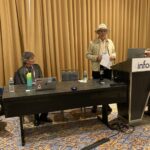





For the Optimization Catalyst podcast (listen here) Steve spoke with Solange Gelman, Director of IT Application Development and Airport Operations Technologies at United Airlines, and David O’Keefe, head of Alliances America at Gurobi. Following are lightly edited excerpts.
David: Solange, you oversee both passenger-facing and operational technologies at United Airlines. Could you give us a quick overview of your portfolio of the key challenges your team is working to solve?
Solange: Everything we do at United is about efficiency. We are trying to be faster, and we do not compromise safety and customer satisfaction. For example, we have systems with algorithms to optimize the shifts for all the employees working the machines at the ramp. We also have systems that schedule the employees performing the cabin cleaning and fueling. All of that is very methodically managed by systems that are optimizing to gain seconds or minutes on the turn, which increases our productivity.
David: Steve, you have so much experience in the transportation industry. What are your thoughts on operational efficiency?
Steve: One thing that Solange points out is that even if you don’t run the airport, as a major user you are very involved in its management. You have facilities, terminals, equipment, planes… This is true in almost all large-scale transportation problems. At a trucking company or railroad, there are different equipment and facilities but similar problems—there is a big network and all the personnel. We often think of the crew upfront, and they are important, but there are also people underneath the wing and there are people in the facility. Tying it all together is a dance 24/7 every single day. People have been working on these operational efficiencies for decades. Now, with new sensor technologies and new data, there is the opportunity to take what might have been a surprise a generation ago and anticipate and work around issues today. You might be able to get ahead of a demand spike, equipment breakdown, or personnel sick-out using predictive analytics and optimization, and improve operations.
David: Steve, I know you are a technologist and innovator. What are the emerging technologies that you’re most excited about?
Steve: Everyone on planet Earth seems to be using AI chatbots and experiencing how powerful they are and how quickly they are improving. How do we take that technology and mirror it up to Gurobi Optimization, to statistical analysis, to get good fact-based information rather than hallucinations? GenAI is very powerful technology because executives and customers can have a conversation with it and ask questions and see alternatives. Everyone’s talking about agent technology. How do we empower the AI agents to use tools like Gurobi that use real mathematics, real data, real statistics to give real answers, rather than just look in the base of previously scraped answers from the web to give what seems to be like a respectful answer? When it comes to decisions and issues that Solange addresses every day–what’s the best schedule, the best response, the best recovery—you want something that’s really rock solid. GenAI presents the opportunity to have a conversation, “What about this? Have you thought about that? Where did you get that information from?”
David: There is an interface to knowledge you can use to make decisions and then also to kick off the optimization models that will ultimately apply that model to make decisions. Is that it?
Steve: What you just said, David, where the AI tool can have a conversation the way an intelligent agent can interrogate—that’s a keeper. It’s great that it can have a conversation like an intelligent human being. The fact that it got its intelligence by scraping the web and absorbing books, and then it seems to want to answer out of its own learning—that we must discard because we don’t want someone saying, “Well, this is how, at United, they answer this question.” That might not be the appropriate answer today. We want to interrogate the same systems that a customer service rep would use and respond to the user, “Here’s the flight that is available for you,” or, “Here’s what your ticket allows or doesn’t allow,” or, “Here’s what crew is available and certified for that job.” If we can do that, these AI bots are going to be thrilling and positive.
Solange: It’s all about the change management with the use of new technologies like AI and chatbots. The human needs to ask the right question because if you ask the wrong question, you will get the wrong answer.
Steve: At one airline, we found the main system of record tended to lag, so employees would go to other sources. For example, there was an internal chat application where employees would comment about whether a tail is coming out of maintenance, and the maintenance guy was either giving a thumbs up or saying we might need another part. That exchange wouldn’t have been entered into the system of record yet, but the information was available in different channels somewhere on the ground, or in emails or voice mails or shared docs that send data back and forth. That information might not be available at that time to an analyst, or an executive, or a user, making management a challenge. If we don’t know whether there’s an incident, that’s a bad thing for data analysis. If employees aren’t using core systems because they are slow or too strict, then we should commission a single set of systems to communicate with.
David: Steve, as a veteran consultant across industries, including the transportation industry, where do you see new AI-driven technologies changing and improving airport operations?
Steve: A couple of generations ago there were people who thought they could run things with their gut and instinct, and no machine could outperform them. I think all or most of those people have retired. However, the current generation is still using fixed rules. They use optimization and AI to change the rules, but the rules are still pretty much fixed: “Every morning up to 80 percent do this, 90 percent do this, 95 percent do that.” I think the state of the art is to take the same technology that created those rules and make them dynamic so that you can essentially change them real-time. Today, we are thinking about tariffs but in six months we might not even remember what that word means. As executives at United and other airlines well know, airports go down and extreme weather events happen on a national scale. For decades, they have been planning in the face of emergencies. There are now new, exciting AI and optimization tools that can help other businesses do that intelligently.